
Overnight Sourdough Artisan Bread Recipe (easy & no scale)
This post may contain affiliate links. Please read our disclosure policy.
Jump to RecipeThis Artisan Sourdough Recipe will easily be your go to recipe for delicious sourdough bread! It’s beginner friendly and so simple, without even using a scale!
I highly recommend this recipe as an overnight bake for flavor and texture, but I do also give you the option of a same day bake if you need it done sooner!

Tools you may need to make this sourdough artisan bread recipe:
Large Bowl
Danish Dough Whisk or you can use a regular whisk and your hands)
2 lightweight towels (one damp and one dry)
A sprinkle of flour for your countertop
Dutch oven for baking: This is important for creating steam and getting your loaf to rise with that perfect crispy crust!
Ingredients:
Water
Active Sourdough Starter (If you need to make a starter, check out my starter blog post here!)
All Purpose Flour (My favorite high quality flour is Sunrise Flour Mill!)

Notes For Same Day Bake:
Like I mentioned above, I highly recommend this as an overnight bake for flavor texture, and for easier digestion (the longer your bread ferments, the more gluten is broken down so you get an easier bread to digest), but I know sometimes you want it that day or just need flexibility for convenience so you can certainly turn this into a same day bake!
For a same day bake, follow the instructions below with these modifications.
(Same day bakes do not go in the fridge)
- After stretch and folds are complete let the dough sit for about 1 hour on the counter, covered with a damp towel.
- Then, shape your dough and place seem side down into a banneton basket (or a bowl lined with a kitchen towel).
- Cover with a dry towel and let sit about 4 hours until the dough has proofed and has slow bounce back when an indent is made with a finger. This time is flexible, but will also deepened on your temperature and moisture in your home.
- Once it is proofed and ready, bake per instructions below.
How to make this sourdough artisan bread recipe:
Whisk together water, starter, and salt.
Mix in the flour. The mixture should be sticky and wet.

Cover the bowl with a damp towel and let it sit for 1 hour.
After an hour, do four sets of stretch and folds 30 min apart, covering with the damp towel between sets. If you need visual instructions making this loaf or the stretch and fold, watch my tutorial here!
After stretch and folds are done, cover with plastic wrap and place in the fridge overnight ((8-12 hours, up to two days). The longer you ferment, the more sour flavor your bread will have and the easier it is for your body to digest.
(if you want to do a same day bake, see the note above these instructions)
Shaping and Baking:
The next day, or when you ready to bake, pull out the dough from the fridge and shape loaf on a lightly floured surface, building tension as you tuck the sides under. You can do this right out of the fridge or let it come to room temp first. Either way will work.
Place shaped loaf upside down into a bowl lined with a dry towel or a banneton basket and pinch the bottom of the dough together. Lightly cover with a dry towel and let it rise at room temp for 2-4 hours.

When you are ready to bake, preheat the oven to 500 F with your dutch oven inside the oven (You want the inside of the dutch oven to be very hot)
Turn your loaf right side up onto a parchment paper, flour the top and score the bread.
Take the dutch oven out of the oven, place the loaf and the parchment paper into the dutch oven, using the parchment paper to lower it in gently.
Bake for 20 min at 500 with the lid on. Remove lid, lower the temp and bake at 450 F for 20 min.
Let cool before cutting (or cut the end off when hot if you are like me and can’t resist a hot end slice of fresh bread!)
Happy baking 🙂
Xo, Emily
This page may contain affiliate links.

Overnight Sourdough Artisan Bread Loaf (no scale)
Ingredients
Method
- Whisk water, starter, salt together.
- Mix in the Flour until well incorporated. Mixture should be very sticky and wet.
- Cover with a damp towel and let sit 30 minutes to an hour.
- Do four sets of stretch and folds 30 min apart, covering with the damp towel between sets.
- After stretch and folds are done, cover with plastic wrap or a lid and place in the fridge overnight for a bulk ferment (8-12 hours, up to two days). The longer you ferment, the more sour flavor your bread will have and the easier it is for your body to digest.
- When ready to bake, remove the dough from the fridge and shape on a lightly floured surface, building tension as you tuck the sides under. You can shape it cold or let it warm up on the counter first. Either way will work.
- Place shaped loaf upside down (seem side up) into a bowl lined with a dry towel or a banneton basket and pinch the bottom of the dough together. Lightly cover with a dry towel and let it rise at room temp for about 2 hours for the final proof. If it is winter/cold you may need to let it rise longer, until you can poke it and the indent has a little bit of a delay in bouncing back.
- When you are ready to bake, preheat the oven to 500 F with your dutch oven inside the oven (You want the inside of the dutch oven to be very hot).
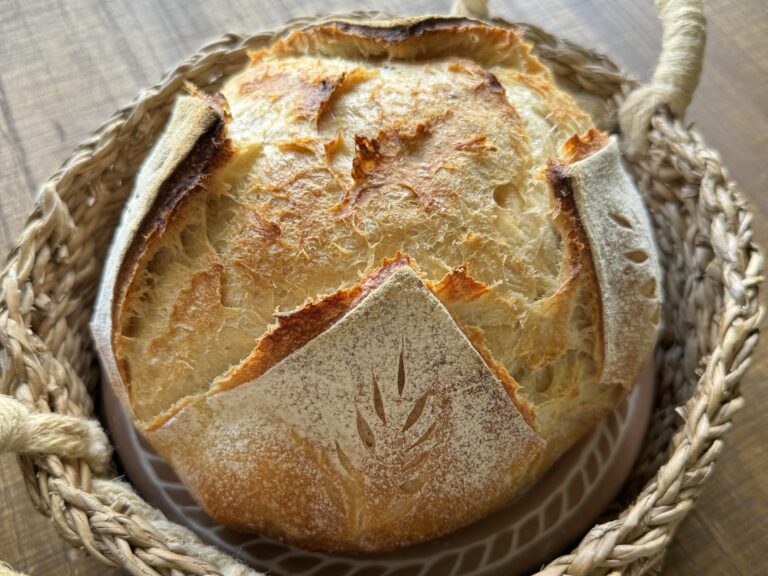
- Turn your loaf right side up onto a parchment paper, flour the top and score the bread with one deep cut and smaller decorative cuts.
- Take the dutch oven out of the oven, using the parchment paper as a cradle for the dough, gently lower the loaf and the parchment paper into the preheated dutch oven.
- Bake for 20 min at 500 with the lid on. Remove lid, lower the temp and bake at 450 F for 20 min.
- Let cool before cutting for best results! (I alwasy cut the end slice off hot out of the oven!)

I didn’t leave the bread fermenting enough, so it fell after rising in the bread pan. HOWEVER the bread had good texture, was soft and tasted wonderful.
I’m new to sourdough so I have a few questions:
1. Can I use bread flour instead of all-purpose?
2. How can I shape this into a batard instead of round? Do you have a tutorial on that?
yes, you can sub bread flour instead of all purpose, and to get a more oval shape bread, you can just tuck the sides under on two sides to change the shape and then place it into an oval banneton basket!
Second time making this loaf and it is a little stickier when doing my stretch and fold, but also has more stretch this time around, so thinking a little stickiness is better than a tight dough
yes, the more you do, the more you will get the feel for how you like your dough and the texture you are going for. You are doing great, I hope it turned out good!
I have had SO MANY sourdough failures; I found your site and “tried again”. NO FAIL! I am very excited. I did the two-day fermentation and the sour is perfect. I am sure with more baking I will breeze through it without being so anal and anxious. Thank you for making this video and your recipes are wonderful. My first loaf was very nice, I am making my second loaf today, it’s a bit stickier than the first, my guess is the humidity level because I am very much a stickler about accurate measuring. One of my scariest things is the scoring. I fear that I will deflate the loaf. But this time I am going to try it as you demonstrated using an Ul (Alaskan blade that looks like a single-blade pastry blender, but sharp as a surgical instrument). Praying for the best! Again, Thank You So Much!
WOW! Thank you for your comment and feedback! I am thrilled that you were able to have a successful loaf and I hope the second one turned out well! The more you do it, the more you will be able to know by feel how you like your dough and bread! The starter that you use can make a big difference on the texture of your dough, so keep at it and you will get better at consistency of your loaves! You are doing great!!
xo, Emily 🙂